


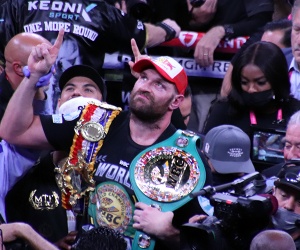
Could ‘The Gypsy King’ upset the odds and reign once more? Looking at the arguments for a Fury victory
Usyk is a worthy favourite heading into the rematch, but write Fury off at your peril
The narrative being portrayed surrounding the gargantuan Heavyweight rematch between Oleksandr Usyk (22-0, 14 KO) and Tyson Fury (34-1-1, 24 KO), is that the brilliant Ukrainian had his hand raised by the slimmest of margins back in May via a split decision, with just a one round swing splitting the two future Hall of Famers.
Of course, according to the scorecards this is indeed the case, however, for me and many who watched the first fight unfold, scorecards aside, Usyk was a conclusive victor, perhaps seven rounds to five or even eight to four, with the 10-8 round in round nine giving him a fantastically contested but clear decision victory.
Given Usyk’s proven superiority in their first battle, he is a warranted favourite with the bookies, most pundits and fight fans. Despite this, given the huge momentum shifts and how the first fight played out, there are so many questions and points of intrigue heading into Saturday night’s hugely anticipated rematch for the WBC, WBA and WBO world titles, that are perhaps being overlooked.
Let’s look at some of the reasons as to why it may be foolish write off the legendary ‘Gypsy King’.
Fury always gets better in rematches
The former WBC king already has two trilogies to his name, against the once most fearsome knockout artist in the sport, Deontay Wilder, and UK cult hero Derek Chisora. Earlier in his career he also rebounded from a poor performance and in the eyes of many, a fortuitous points win over domestic level bruiser John McDermott, before knocking him out in their rematch.
It was in the second fight against Deontay Wilder however, when we really saw Fury’s elite ability to take lessons from a first meeting, tactically adapt and enforce an entirely different outcome next time around. Despite being widely perceived as the deserving points victor in their first battle, boxing beautifully on the backfoot for the ten out of twelve rounds that he didn’t touch the canvas, Fury shocked the world by taking the fight to Wilder in the rematch. In doing so he neutralised his threat by putting him on the defensive, using his size and implementing smart, calculated aggression, maintaining centre ring and gradually beating him down.
Many are predicting that Fury will look to make similar adjustments in this, most critical rematch of all. If fighting in this more authoritative way from the outset, could we see a different fight play out?
Did the scar tissue from his cut eye inhibit his preparation before?
Everybody knows what happened with Fury and Usyk’s first scheduled meeting being postponed just two weeks from fight night, with Fury sustaining a gruesome gash over his eye in one of his final sparring sessions. Whilst not making an excuse and accepting he is responsible for agreeing to the rescheduled date of May 18th, he has made it known that this effected his preparation, having to protect the injury with limited sparring.
Sparring is obviously a vital component of any training camp, improving cardio, conditioning the body for the pain and mental battles of the fight itself, and of course sharpening your timing like no other training method can.
Could this limited sparring have had an effect on Fury’s performance last time out? Usyk certainly settled the quicker and looked the sharper of the two, before Fury found his range and had a great mid-point of the fight. Perhaps with a full training camp of countless top-quality rounds, picking up from round 13 as they say, could it be Fury who finds his feet first and takes authority from the off?
Acceptance of the need to change tactics this time out
For me this is what makes the fight the most intriguing and gives me the greatest question as to who will come out on top. It was bemusing to witness throughout their first fight, the genuine apparent belief from both Fury and his corner that he was banking the majority of the rounds boxing off the backfoot. In Fury’s mind he had a clean sweep of the first seven, with his father John Fury even telling him heading into the final stanza, ‘don’t take any chances at all’ evidently feeling that they had a clear lead.
It is difficult to understand how they could have been reading the fight so wrongly, showing complete disregard for Usyk’s effective aggression, better ring generalship and superior output. Perhaps those pitter patter shots Usyk sometimes throws in the early rounds, maintaining the pressure with relentless footwork, before stepping up the power of the shots as the fight wears on, didn’t feel like they were registering significantly and giving Fury an illusion as to how the bout was being perceived. The reality is that those straight lead back hands and looping left hooks were snapping Fury’s head back and sending sweat flying repeatedly.
Regardless of the reason for this humungous error in judgement, if Fury is able to accept the fact that the judges will score close rounds for the man maintaining centre ring and forcing the pace, he should be able to make the sensible tactical adjustment to fight the same way he did against Wilder in the rematch, and of course as he did against Usyk in rounds four to seven.
Dominance in rounds four to seven
This section of the fight is what will give Fury immense belief that he can end Saturday night in possession of three of the four main world title belts. Finding his range, in the mid part of the fight he really started to tee off on Usyk. Putting more meat on his punches, a repertoire of chopping right hands down the pipe, guard splitting right uppercuts and clubbing right hooks to the body began to reign in.
It was reminiscent of Wilder II, where still defensively aware and coy, Fury took the initiative and brought the fight to his adversary. Still using his boxing brain and setting up his shots beautifully, but this time on the front foot and dictating the tempo.
Standing at 6ft9 and with a far superior reach, there is no reason why Fury should have allowed the 6ft3 and several stone lighter Usyk to push him back in the first place. In this small sample of rounds, Fury was able to keep centre ring whilst maintaining his desired longer range simultaneously. We saw a great example of this in round 5, with Usyk under heavy fire and bouncing around the perimeter of the ring, the crafty southpaw looked to engage from outside of his shorter reach, with Fury adjusting his feet with a half step back before whipping in a brutal right uppercut, sending Usyk wobbling back for the first time in the fight. These are surely the tactics Fury will realise he needs to employ from the off come Saturday night.
The issue? Usyk came roaring back to bust Fury’s nose in the eighth and make his legs turn to jelly on the brink of a stoppage defeat in the ninth. It is a risky strategy, but unfortunately for Fury, I believe it is his only chance at victory.
Conclusion
There are so many fascinating questions that only the warfare that will ensue on Saturday night can answer. Can Fury make the necessary tactical adjustments? Will he be able to settle into the fight quicker than before? At 37, will Usyk be able to keep up with a more assertive and physically dominant Fury? At 36, will Fury himself actually be capable of implementing these tactics without gassing out? In being more aggressive, might Fury actually play into the tactically brilliant Usyk’s hands even more? Even if Fury does manage to successfully implement a different gameplan, could Usyk do what he always seems to do in adversity, and find yet another gear?
Given how the first fight played out, you have to say Usyk is a worthy favourite. Yet for the reasons mentioned above and purely for the fact that this is Tyson Fury we are talking about, you can’t help but have a creeping feeling he might just shock us all once more.
Regardless of who comes out victorious, Saturday night promises to be a spectacular crescendo to what has been a remarkable year of big-time boxing. If Usyk wins, his dominance over this generation will be forever unquestioned. If against the odds, Fury does manage to turn the tide, it will tee up one of the most remarkable trilogies in Heavyweight history.




