


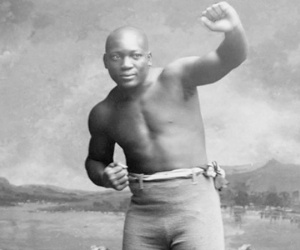
Tribute to Jack Johnson
Tribute to Jack Johnson on his 126 birthday
Much of the legend and mystique surrounding John Arthur Johnson, better known as the legendary boxer Jack Johnson, stems from the fact that he is from an entirely different era and way of life, not just in boxing, but in wider society.
Johnson’s long and historic journey began in Galveston, Texas, where he was born on March 31, 1878 to former slaves.
Johnson was the third of nine children, and remarkably rose to become the first black heavyweight champion in history when the oppressive Jim Crow era was in full effect in the United States. To succeed when you are not supposed to, to succeed when your life is in genuine danger if you do, takes something special.
The “Galveston Giant” proceeded to become the first black heavyweight champion in the hardest way imaginable. Johnson fought during a time un-fathomable to those born during the significantly more liberal world of today. Back then, white fighters openly refused to fight black fighters. Whilst champion, James J. Jeffries said: “When there are no white men left to fight, I will quit the business. This fellow Johnson is a fair fighter, but he is a black, and for that reason I will never fight him.”
Due to the colour of his skin, Johnson had to wait 11 years to be given a world title shot. Nevertheless, this did not deter a journey towards legend. Rather, the struggles only embellished the legacy of Johnson. Johnson overcame colossal adversities outside of the ring and displayed a style inside of the ring which was a timeless mastery of the Noble Art.
During a time when a black man looking at a white man the wrong way may result in death, Johnson maintained an adamant determination to remain his own person, both inside and outside the ring. During a time when a black man could be lynched for even looking at a white woman, Johnson married them.
To quote Ken Burns’ documentary, “Unforgivable Blackness: The Rise and Fall of Jack Johnson”: “Black Americans at the turn of the 20th century were no longer enslaved, but not yet truly free. Jack Johnson insisted on being free.”
After years of being denied the chance to fight for the heavyweight title, with Johnson following the white heavyweight champion Tommy Burns around the world in an attempt to bait him into the ring, Johnson finally got his opportunity against Burns at Rushcutter’s Bay, Sydney, on December 26, 1908. Johnson made Burns pay for all the years of annoyance and discrimination, punishing and taunting the outclassed Canadian until the police intervened and stopped the fight in the 14th round. Seeing a black fighter knock out a white man was seen as totally unacceptable.
Immediately, the search for “The Great White Hope” started. Johnson marked the origin of this expression, which was used for any white opponent who stepped into the ring with Johnson to attempt to rid him of the heavyweight title, and the term has been in existence ever since.
Middleweight great Stanley Ketchel put Johnson on the canvas in the 12th round with a big right hand, before Johnson rose and knocked Ketchel out with the very next punch, with several of Ketchel’s teeth infamously embedded in Johnson’s right glove, with Johnson seen brushing these teeth off his glove as a comatosed Ketchel is counted out.
Next up was former champion James J. Jeffries in the original “Fight of the Century”, tempted out of retirement and exhorted by novelist Jack London to “wipe the smile off the nigger’s face”. All the present spectators were searched for firearms prior to entering the arena, illustrating the hostilities, bad blood and ill intentions of the day. The fight was held on Independence Day, which is meant to celebrate what the Declaration of Independence stands for, which is: “We hold these truths to be self-evident, that all men are created equal, that they are endowed by their Creator with certain unalienable Rights, that these are Life, Liberty and the pursuit of Happiness.”
On 4th July 1910, this declaration was far from reality.
“I should step into the ring again and demonstrate that a white man is king of them all,” Jeffries said.
Johnson climbed into the ring first, as was his superstitious insistence, smiling, looking cool and confident. Jeffries entered second, and refused to shake Johnson’s hand.
In his book, “My Life In the Ring And Out”, Johnson said: “It was hinted that gunmen had been hidden in the crowd and that if my boxing opponent did not dispose of me a bullet would. I took little stock in this. I could not imagine any sportsman sunken to such depths, yet such rumours served to indicate the hostilities that existed.”
Johnson continued to state: “Despite the sun and the jeering mob and the occasional thought that there might be a gunman somewhere in that vast array of humanity, I do not recall that I was greatly disturbed. ‘The golden smile’ for which I have become famous, I am told, never deserted me, and there was no reason why it should have.”
That smile and cheerfulness helped Johnson to conquer his era, and this Jeffries fight was the best example. Johnson had to walk through and fight in front of a hostile crowd, the like of which would be unimaginable today, and Johnson was just there in the ring, smiling, being polite and loving life. His smile would enrage his enemies, and was the most effective means of conquering the racism and malevolence of the day.
To quote Ernest Hemingway: “Courage is grace under pressure.”
As Johnson stated in his autobiography: “I realised that my victory in this event meant more than on any previous occasion. It wasn’t just the championship that was at stake - it was my own honour, and in a degree the honour of my race.”
Johnson was fully aware of the significance the public had placed on this fight, which must have surely brought feelings of pressure, which makes Johnson’s cool and composed nature throughout the duration of the event all the more commendable.
Johnson pounded Jeffries to the canvas three times in the 15th round, and Jeffries’ corner stopped the fight to avoid an embarrassing knockout, as well as further damage, both figuratively and physically. Johnson’s victory ignited celebrations amongst urban blacks across the country, which then resulted in race riots with more than 20 people dying, and many more were injured.
The public hated Johnson not only because he was the black conqueror of ‘white hopes’, but because he did not follow the unwritten codes of black behaviour. He was out-spoken, cocky, spent lavishly on clothes and fast cars, and ignored one of the biggest taboo’s in white America, as his relations with white women certainly made matters worse with regards to the prejudice Johnson experienced.
Johnson lived without fear. Every time he stepped into the ring, he could have been killed at any moment by the all-white crowds that were there just to see him lose, but he conquered evil.
Johnson’s prowess in the ring and his courage, along with his boastful and larger than life character, made him one of the first iconic black celebrities in the world.
One thing is absolutely undeniable. Johnson was a truly special fighter inside the ring. His significance outside of the ring cannot take away from this fact. For his time, he was a genius. Regarding ring IQ, he would score nothing less than ‘profoundly gifted’. He would draw his opponents in, patiently waiting for a mistake, in order to counter-punch with terrific speed and when necessary, tie his opponents up and sap their energy. He relied on tremendous uppercuts in many of his fights whilst grappling on the inside. Johnson’s intelligence was unprecedented at the time, a huge asset in the ring. He was technically original, using brains to accompany his natural physical gifts. Defensive prowess matched with power, agility and speed. To this day, Johnson remains the finest defensive boxer in heavyweight history.
Legendary trainer and owner of renowned Stillman’s boxing gym, Lou Stillman said: He (Johnson) could do everything better than any other fighter. He was a terrific puncher at long range. Even Jim Corbett and Bob Fitzsimmons, who rated Jim Jeffries over him as a fighter, said Johnson was the greatest defensive battler in history. He was a master of the lost art of feinting."
Johnson was an avid reader, a self-educated man who was a student of history and an admirer of Napoleon, and his intelligence transferred to the ring to make him one of the greatest heavyweights of all time.
Johnson unquestionably lived a remarkable life. He redefined the art of boxing, whilst simultaneously showing brave defiance against racial oppression, changing the course of cultural and sporting history.
In My Life In The Ring and Out, Johnson said: “I am astounded when I realise that there are few men in any period of the world's history, who have led a more varied or intense existence than I.”
As one of the most fascinating individuals ever, one whom lived an extraordinary life, his statement could not have been any truer.




