

Rear View Mirror - Ferdie Pacheco
Rear View Mirror - A look back at the remarkable career of 'The Fight Doctor' Ferdie Pacheco
GBN's Caledonian columnist, Donald C Stewart, takes a look in his rear view mirror at the wonderful career of 'The Fight Doctor' Ferdie Pacheco
"It's with a heavy heart that I have to announce to the world the passing of my wonderful Dad, Ferdie Pacheco. He was a pharmacist, a doctor, a boxing commentator, a painter and a writer. But to me he was just Papa. It's a heartbreak to lose a parent, but I know he'll always be with me."
I think having recently reviewed the Russ Abner memoire, I have become ever so slightly obsessed with people outside the ring who are critical to what happens within it. It led me back to one guy who I had been aware of many years ago and intrigued me because of his career outside of boxing – he became an artist, having been Muhammad Ali’s cornerman.
It was when Ferdie Pacheco passed, I started looking into who people wanted to acknowledge their debt to him. I saw tribute after tribute pour towards a man whose name was never on many of our minds, but whose dedication was evident for all when we sat and watched with awe at the fights where his expertise gave many fighters more than just a fighting chance. I think I know how important people around boxers are because I know how many people it takes to get a guy in shape, to mentally prepare them and to make sure that, whilst they are in the ring, they are switched on to what they ought to be doing. That care and duty to care extends far beyond that ring too.
At 89 years of age, Pacheco wore the title veteran with poise and grace. The announcement of his death was relayed to the world through Facebook – see above – in a loving tribute form his daughter. It was testimony to how we ought to pay attention to this new world and not be fooled into thinking the old world cannot cope with it.
His daughter wrote touchingly of a man who had such a varied life – he was a pharmacist, a doctor, a writer, a painter and a commentator – which was enough to intrigue, fascinate and hook me from hundreds of miles away.
As I looked deeper into this monumentally important man, I realised that whilst his name had not graced my lips it had graced the lips of giants of this sport, had spoken hallowed words and been a colossus in the graced halls of commentary and analysis as he had an insight that went far beyond an insider and into the realms of a man who just knew.
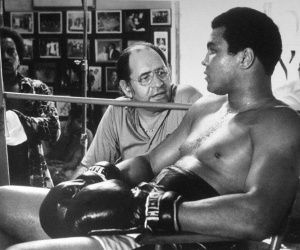
Born in Tampa, Florida as Fernando Pacheco Jiminez, he qualified through the University of Florida as a pharmacist and then the University of Miami as a doctor, Pacheco found himself in the company of Cassius Clay in 1960 when Clay was training at the 5th Street Gym in Miami Beach.
The legend goes that Angelo Dundee offered him free tickets if he would help stitch up his fighters – as introductions goes this must be right up there with the best of them! He became known as “The Fight Doctor” and was used not just by Ali – he was in the corner for no fewer than 12 world champions.
In just over 2 years he was to be a permanent feature in the Cassius Clay corner, and he stayed there up until 1977 when he left. He cited as his reasons, the fact he thought Ali should retire, or at least take on guys he could beat easily. It came after Pacheco gave Ali physical reflex tests which gave Pacheco cause for concern, but it did not trouble The Greatest.
But during the 17 years he was a critical part of the Clay story no more so than when alongside Angelo Dundee in the corner, Ali fought Sonny Liston the first time. Pacheco was to prove his worth as people believed Ali's blood pressure had risen exponentially at the weigh-in. Pacheco was asked to examine Ali away from the crazy atmosphere. Ali admitted to him that he was acting "crazy" to scare Liston. Pacheco’s examination showed that Ali’s blood pressure reading was normal!
But like many stories the true value of the man came when he took a stand, and this came the first time he tried to get Ali to stop, in 1975 straight after the Thrilla in Manilla with Joe Frazier. Pacheco had become concerned about the increasing blows absorbed by Ali and begged him to give it all up. Ali refused. By 1977 though Pacheco was unable to put to the side his concerns and found himself on the outside, advocating retiral. Ali would still not heed him and fought on. Pacheco tried one more time and when he wrote to Ali and got no reply, he realised that there was no chance of him succeeding in getting Ali to give it all up.
Worryingly Pacheco apparently later explained, "The New York State Athletic Commission gave me a report that showed Ali's kidneys were falling apart. I wrote to Angelo Dundee, Ali's trainer, his wife and Ali himself. I got nothing back in response. That's when I decided enough is enough."
Despite their disagreement, Pacheco and Ali remained friends and came together again in 2002, when Ali told his former doctor, "You was right." Later on in life Pacheco was fairly sanguine about Ali. USA Today asked if he felt sorry for Ali who suffered from Parkinson’s he replied, “no. He had the greatest life any human being can have. There’s no way — no way — he could have lived better”
“The Fight Doctor” was, however, so much more than simply Ali’s cornerman. He became a TV analyst for NBC, Showtime and Univision. These brought him two Emmys and there is little doubt that a guy who was part of that massive Ali entourage, who did it all for free, would have had plenty to contribute about the sport from a very unique and knowledgeable perspective.
He also campaigned for better boxer safety including demanding that ambulances be present at every fight, made the change of 4 ropes in the ring to prevent deaths, and advocated the idea of thumb less gloves to prevent eye-injury.
His career as an artist also flourished. Amongst the accolades he collected, his paintings are on the walls of celebrities including Andy Garcia, Evander Holyfield, Shirley MacLaine, and Petula Clark. He also has a stamp with his painting of Gandhi on a U.N. Postage Stamp, unveiled on October the 2nd, 2009 at the United Nations on the International Nonviolence Day which is Gandhi’s birthday. He also won the Gold Medal and First Prize in Tonneins, France : the First Prize, Best Colorist at Musee Du Luxembourg. He was the author of several books, plays, screenplays, and short stories.
Once again, you scratch the surface of someone closely associated with the sweet science and it reveals deep and hidden depths in amongst the savagery that draws you in. Then on the 16th of November 2017, peacefully in his sleep, at 89 years old, at home he slipped away. What he left was a legacy that was nothing short of remarkable.