

Book Review - Russ Anber: A boxing memoir
Unrivalled By Paul Harrietha - Russ Anber: a boxing memoir
Book Review by Donald C Stewart, Global Boxing News
When I first started to watch boxing, I knew very little and was more concerned about the two people in the centre of the ring than anybody else – to be fair I was more interested in one out the two. Of course, I knew there was a referee and other people around who seemed to be necessary, including the judges, but you didn't really take much notice of them. I was so ignorant when they shouted, “Seconds Out”, I thought, that meant that they only had a very short time to leave the ring!
As I watched more and listened, investigating and interrogating what is happening in boxing, the more I become aware of other figures – outlandish promoters, dour-looking trainers, or those very seconds themselves. Russ Anber’s boxing memoir, penned by Paul Harrietha, including a foreword by fellow Hall of Famer, Thomas Hauser, is an overview from boxers, trainers, cut-men, hand wrappers, providers of quality gear and material – and they are all Canadian legend, Russ Anber.
Anber was a name I had heard, and as I was reading this book, I listened in to a Matchroom podcast with boxers Pat Brown and Dave Allen. They referenced Anber in a discussion Brown had with him to delve deep into Anber’s boxing knowledge, but he came away with an increasing respect for the man due to his ability to shine with his magic tricks and a pool cue!
Harrietha has a tough job and an easy task as he has corralled a huge number of sources to tell the story of a man who began as a keen young sportsman whose initial sports career was cut short because of his size. Anber gravitated towards a sport that gave smaller people a level playing field, due to its weight categories – boxing.
One of the impressive approaches taken by Harrietha, is how quotes from people are held aside from the main narrative allowing all people in Anber's life, like his family, to have equal footing with those who are professional sports people. All are no less important to Anber than the millionaires and world champions he has dazzled with his brilliance.
Another innovation is a number of QR codes where, if you want to learn more, you scan the code and go and visit the relevant web resource. There are over 20 and they really do add to the story, it's a nice touch.
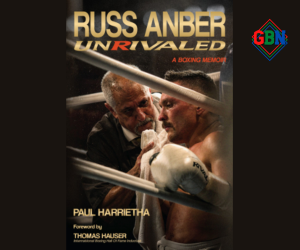
This is a life well told. Anber may have been worried that he was going to miss people out and there must be people not managed to make the edit, but this is a sprawling tale. It begins by following the front-page cover, which shows Oleksandr Usyk being spoken to by Anber, whilst sporting Anber’s Rival branded gloves. After his fight with Fury, Usyk at his press conference branded Anber magic – it is hard to argue with the boxing great, given the story here told.
Crafted around the old championship distance of 15 rounds, we enter Anber's career, in his live by the sword, die by the sword mentality. In the next 400 plus pages, this is a remarkable career but one marked out by his humility. And speaking as a teacher, when Anber talks about seeing himself mainly as a teacher, he absolutely is. From learning his father's commitment to traditions and family, instilling in him a thirst for knowledge, understanding the nuances of boxing, of how Ali and Frazier could be lauded by a mainly white country, and yet be treated so badly, recognising that boxing was a sport over which he could have a positive influence, it stutters when as he became the head of an amateur movement where he could not quite achieve the changes he sought.
The narrative tells how Anber grew through the amateur movement, Olympic cycles, then into professional roles which grew sideways from being a trainer to not being a jack of all trades but a professional master of many, not least of which is the hugely important skill of hand wrapping. His skill is consistently referenced amongst world champions throughout the book. Damaging your hands in the pursuit of glory is a constant, having Anber wrapping your hands with a scientific approach to it, minimises that risk considerably – ask the Smith brothers, Derrick Chisora, Vasily Lomachenko, AJ, Oleksandr Usyk and many others. It led to Anber founding and developing the Rival Boxing brand as he observed from the corner of so many champions.
At the age of 18 Anber was given his big chance by Vinnie Curto then a two-time world championship challenger. It led to Anber rubbing shoulders and absorbing knowledge like a sponge, with many of the greats including a 30-second chat with legendary Angelo Dundee. Never daunted by hard work, running round the North of America Anber took in as much as he could whilst trying to make ends meet.
Harrietha, though, does not shy away from the dark side of boxing including its politics, the promoting game – Don King especially – and the vagaries of being a trainer let down by fighters who left and prematurely dropped him. There is also mention of Cleveland Denny who died from his injuries 17 days after a fight on a Duran – Leonard undercard as witnessed by Anber. The experience instilled in him a desire to save his fighter for another day, something which he goes back and forth over, often talking of how some trainers and some corners would not do as he did and pull their fighter out, risking their fighter’s health.
What also runs through the book are tales of his ability in magic tricks and with a snooker cue. I was delighted to see reference to Canadian former world champion Cliff Thorburn, a favourite of mine in 1980s.
But of his boxing success there are plenty of mentions. His ability to prepare fighters, improved Harold “Shadow” Knight, the IBF USBA super featherweight champion, who confirms how Anber made a difference to him. There are plenty of others who talk about the training regime that Anber used which enhanced their ability to hold on to their championships or to get one in the first place. There are also opportunities for fighters to demure and note why they did not “buy into” the Anber philosophy, like David Lemieux who did not like the way their relationship ended – his point of view is quoted, as is the credit he gives to Anber for improving him – that’s respect. Anber is also honest enough to recognise when he saw young boys, forgetting they had grown into full grown men. That adds honesty through authenticity to the telling of his tale.
One of Anber’s greatest achievements, as he claims, and why books like this are so valuable, is when he talks about Ron Donaldson as one of his greatest achievements as a trainer. Anber built him up from having very little by way of natural ability into a Commonwealth Games gold medallist and an Olympian. Not a world champion but a bigger champion because of the distance his career travelled with Anber in his corner.
Whilst humble, Anber is never short of an opinion. Scorn and criticism are reserved for officialdom as well as ongoing disputes with boxing officials.
His broadcasting career which includes six Olympics and multiple Commonwealth Games has testimony from many co-hosts that Anber was a natural for the camera.
And so, the book ends with a deep dive into the first Oleksandr Usyk vs Tyson Fury fight. I don't think I have read a better detailed summary of what happened with such a degree of insight.
It is that honesty which allows students of the sport access to true insight and knowledge. Usyk calls Anber magic, and I am in his spell after this book. Dripping throughout is the authenticity of a man who not only has been there, seen it all, bought several T-shirts, but fulfilled roles that those at their highest level of ability feel that he is a master. Harrietha has captured that completely.
Discount code: BRITBOXINGNEWS15 for 15% off